
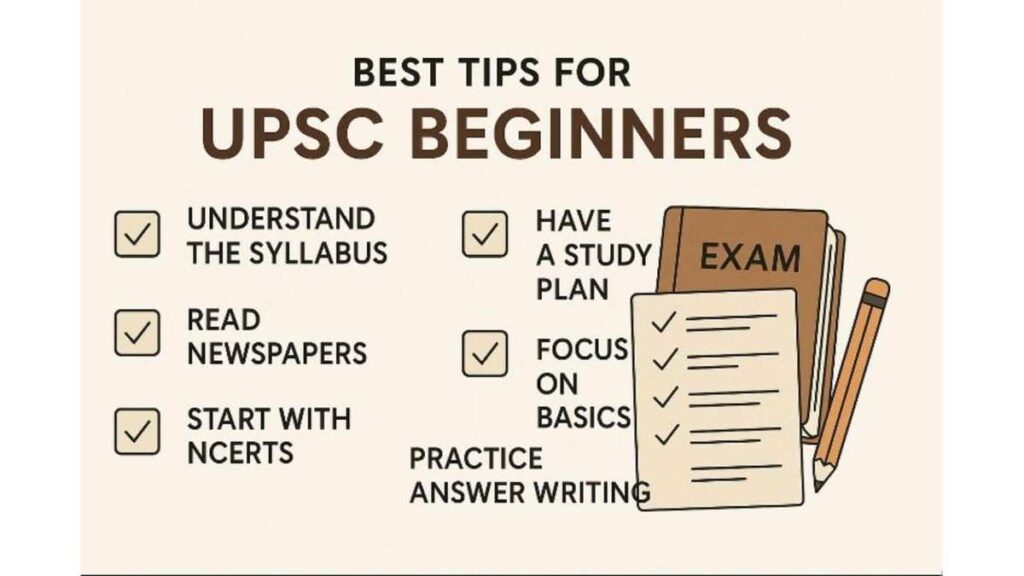
Preparing for the UPSC civil service exam in six months is difficult, but it is not impossible. The UPSC CSE is India’s most prestigious and challenging exam. Preparing for UPSC in 6 months requires a well-planned strategy, dedication and smart work. Many aspirants feel scared because of the vast syllabus and intense competition. UPSC preparation is not about studying everything. It is about studying the right things in the right way. With proper planning, limited resources, and regular revision, six months can be used effectively.
How to prepare for UPSC in 6 months:
Create a Timetable:
A timetable gives clear direction about what to study, when to study, and how much to study. It reduces confusion and increases confidence. When daily goals are achieved, motivation also increases.A simple, realistic, and flexible timetable can make UPSC preparation more organized and less stressful. With discipline and dedication, a well-planned timetable can lead aspirants closer to success in the UPSC examination.
Understand the UPSC exam pattern:
The UPSC civil service examination has three stages:
- Preliminary examination (prelims) – Objective type question
- Main examination (mains) – Descriptive written exam
- Interview (personality test)
The Prelims is a qualifying exam, but the mains decide the final rank. The prelims include two papers: general studies (GS) and the civil services aptitude test (CSAT). In six months, aspirants should prepare for prelims and mains together. Studying only for prelims can create problems later in mains. The mains exam comprises nine papers, including essay writing, general studies, and optional subjects, understanding the exam pattern and syllabus is crucial and developing an effective preparation strategy.
Start with NCERT books:
The first two months should be dedicated to NCERT books because they build strong basic concepts. NCERTs explain topics in simple language and are very helpful for beginners.
Important subjects to study from NCERTs:
- History
- Geography
- Indian polity
- Indian economy
- Science
While reading NCERTs, students should make short and clear notes in their own words. Do not try to memorize everything. Focus on understanding concepts, causes, and effects. NCERTs are also useful for revision before the exam.
Use limited standard books:
After completing NCERTs, the next two months should be used to study standard reference books. One common mistake aspirant make reading too many books. This creates confusion and wastes time.
Some commonly used standard books are:
- Indian polity – M. Laxmikanth
- Modern Indian history – Spectrum
- Geography – G.C. Leong and an atlas
- Economy – Basic economy books supported by current affairs
- Environment – Shankar IAS book
The main rule is one book, multiple revisions. Reading one good book three to four times is better than reading many books only once.
Importance of current affairs:
Current affairs are very important for all stages of UPSC, candidates should read one good newspaper daily, such as The Hindu or The Indian Express. Newspaper reading should focus on important topics like government schemes, economy, environment, international relations, and social issues.
There is no need to read political news in detail. Focus on issues, not daily events. Monthly current affairs magazines are useful for revision. Candidates should mainly prepare current affairs of the last 1 to 1.5 years, as UPSC often asks questions about recent developments.
Answer writing practice for mains:
Answer writing is the most important part of the mains examination. From the third month onwards, candidates should start regular answer writing practice.
A Good answer should have:
- A short and clear introduction
- A structured body with points
- A positive and relevant conclusion
Practicing 2-3 answers daily helps improve writing speed and confidence. The answer should be written in simple language. Using diagrams, flowcharts, and examples makes answers more effective. Time management is very important, so answers should be written within the given time limit.
click here to access offical site
Focus on prelim preparation:
In the last two months, full focus should be on prelims preparation.
This includes:
- Daily practice of MCQs
- Regular revision of all subjects
- Taking full-length mock tests
Mock tests help in improving accuracy and time management. After every mock test, it is very important to analyze mistakes. Learning from mistakes is the best way to improve performance.
CSAT should not be ignored. Even though it is qualifying in nature, many candidates fail due to lack of practice. Regular practice of comprehension and basic math is necessary.
Revision and time management:
Revision is the key to success in UPSC, especially in a short time like six months. Every subject should be revised at least three to four times. Short notes, mind maps. And charts help in quick revision.
A daily study routine of 8-10 hours is sufficient if followed consistently. Fixed study hours, regular breaks, and proper sleep help maintain concentration. Avoid social media, unnecessary mobile use, and comparisons with other aspirants.
Maintain a positive mindset:
Mental strength plays a very important role in UPSC preparation. Candidates should stay calm and confident. It is normal to feel stressed, but panic should be avoided. Believe in your preparation and trust your strategy. Consistency is more important than studying for long hours once in a while.
Quick tips:
- Prioritize high-weightage topics.
- Use smart work techniques like mind maps and flowcharts.
- Consistency is key; even 4-5 hours of focused study is better than 10 hours of scattered study.
Conclusion:
Preparing for UPSC in 6 months requires a well-planned strategy, dedication, and smart work. With a clear understanding of the syllabus, strong basics from NCERTs, limited standard books, regular current affairs study, continuous answer writing practice, and multiple revisions, aspirants can crack the UPSC and achieve their dreams. Stay positive, stay focused, and believe in yourself.